Last night, I gathered all my semi-precious stones and crystals and placed them carefully on the balcony’s parapet, open to the night sky. One by one, each piece found its place. Alongside them, I kept a glass bottle of drinking water. I have done this for the past two years. Every full moon, without fail, I take the crystals out to recharge, letting them rest under the moonlight.
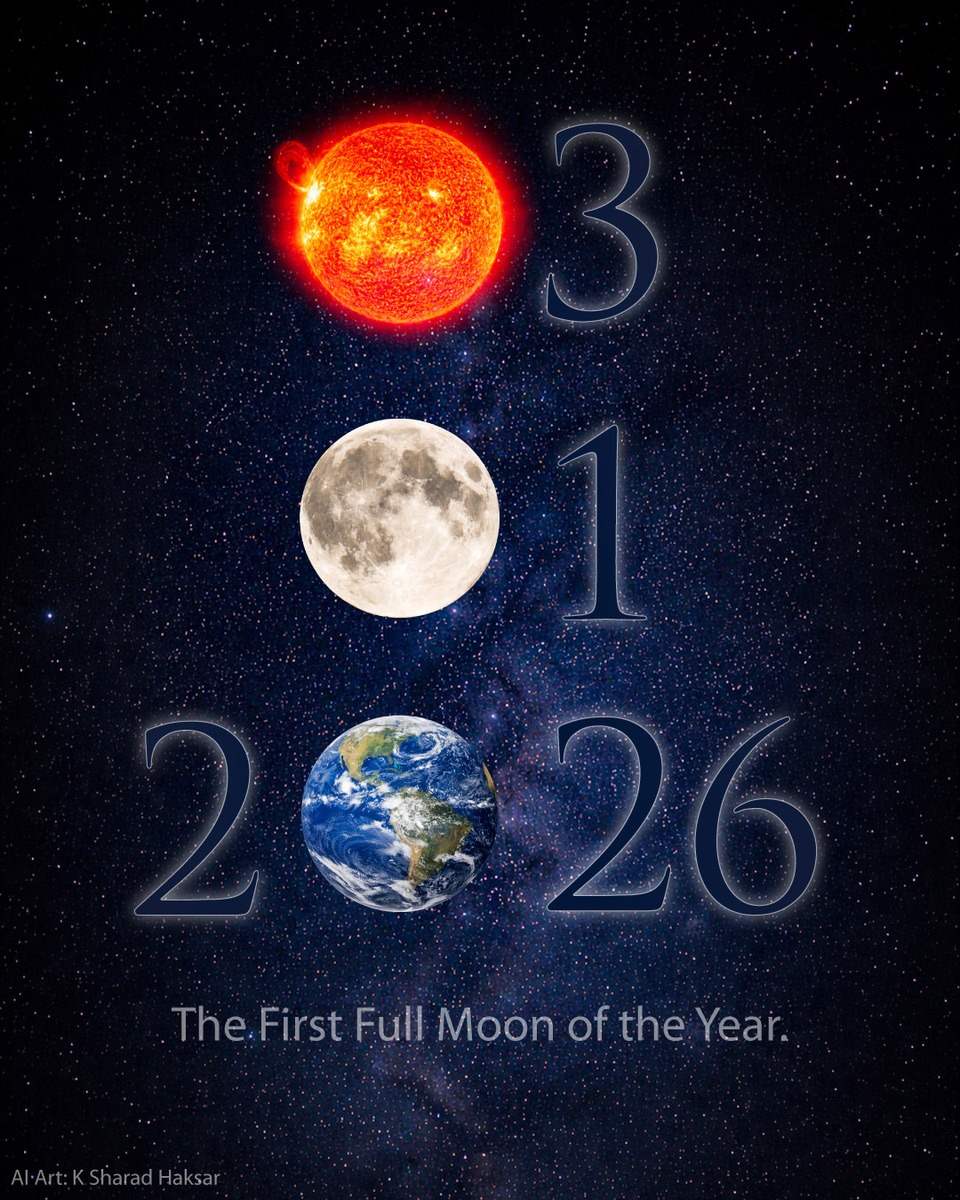
January 3rd is the first full moon of 2026. The peak will be at 3:34 pm in Chennai, right in the middle of the afternoon, when the moon is invisible to us. So I set my alarm for 5 am. That hour, just before sunrise, is when the moon feels closest. It is still night, yet the world is already preparing to wake up.
I stepped out with my pendulum while the sky was still holding on to its darkness. I did my clearing slowly, without rushing it. After that, I sat down and chanted Om 108 times. There was no effort to reach anywhere. Just breath, sound, and awareness.
The moon this morning was red-orange, soft and warm, growing larger as it slid toward the horizon. As I finished my chanting and opened my eyes, it disappeared behind passing clouds. For a few seconds, there was only the sky.
Then the clouds moved, and the moon showed itself again. Some moments gain value only when they leave and come back.
I have always been drawn to the sky. Stars, planets, the sun, and the moon have held my attention since childhood. The more I learn, the more it doesn’t feel accidental.
The sun’s diameter is about 13,92,700 kilometres. The moon’s diameter is about 3,474 kilometres. That makes the sun roughly 400 times larger than the moon. What makes this even more remarkable is the distance. The sun is also about 400 times farther away from us than the moon. Because these two ratios are so close, the sun and the moon appear almost the same size in our sky. This is what makes a total solar eclipse possible, when the moon can cover the sun so precisely that daylight briefly turns into dusk. If those numbers were even slightly different, that alignment would never happen.
While the Sun–Moon relationship works on a ratio of about 400, the number 108 appears elsewhere in ways that are just as striking. The average distance from the Earth to the Sun is close to 108 times the Sun’s diameter, and the distance from the Earth to the Moon is close to 108 times the Moon’s diameter. These are not exact matches, but they are close enough to have been noticed long before modern instruments.
In Vedic thought, 108 comes from nine planets moving through twelve zodiac signs. Ayurveda speaks of 108 marma points in the human body. Yogic traditions talk of 21,600 breaths a day, divided evenly between solar and lunar cycles. A mala carries 108 beads for the same reason. The number shows up in the sky, in the body, and in daily rhythm, not as proof of anything, but as a pattern quietly worth noticing.
As a photographer, this never stops astonishing me. On a full moon night, if you shoot a long exposure, the landscape can look almost like it was photographed during the day. The shadows fall sharp and defined, the details remain, and only the colour of the sky gives the time away. The moon acts like a massive white reflector, bouncing sunlight back to Earth. It does not produce light of its own. It simply returns what it receives.
That, to me, feels symbolic. The moon does not compete with the sun. It complements it. It’s a small reminder that reflected light can still show the way.
In Hinduism, this full moon is known as Pausha Purnima. It is traditionally associated with cleansing, restraint, prayer, and inner realignment. Pausha itself speaks of nourishment and quiet strengthening. A calmer pace instead of noise. A moment to set the tone gently, without rushing.
God Bless
K Sharad Haksar
Dowser | Photographer | Creative Director
#KSharadHaksar #Dowser #Dowsing #Spirituality #FullMoon